Part I · Recognition
Results do not speak for themselves.
Value is created by individuals and attributed by systems, and those systems favour whoever controls the narrative.
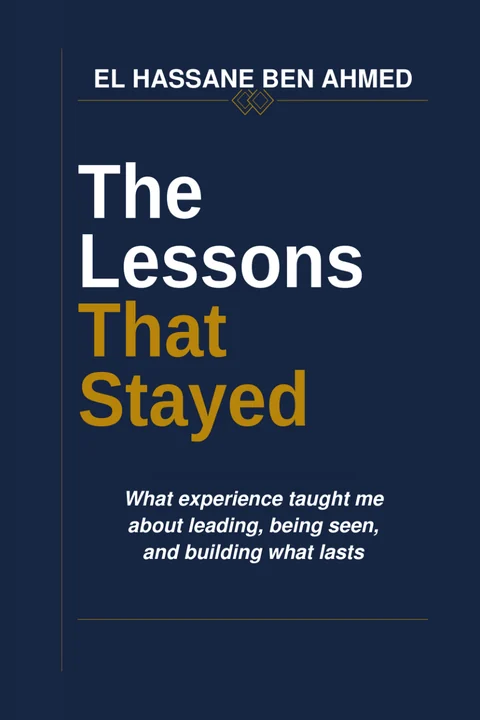
A book by El Hassane Ben Ahmed

What experience taught me about leading, being seen, and building what lasts
El Hassane Ben Ahmed
Twenty chapters. Four parts. One argument.
About the book
Results matter. So do the relationships, cultures and structures around them.
Drawing on thirty years of international leadership experience, El Hassane Ben Ahmed explores the gap between merit and recognition, the cultures that shape careers, and what makes performance last.
Twenty chapters bring together personal experience, historical case studies and management research across four parts. Inspired by earlier LinkedIn posts, these reflections take a deeper look at the human side of leadership.
“Excellent work is not enough. The organisations within which careers are built are social systems, and social systems do not automatically reward what they should.”
Each chapter opens with a narrative from a historical figure, then connects that story to original argument, research and personal experience.
Light citations throughout, and a full bibliography of more than 250 references at the back.
From the Afterword
What each part of the book taught its author, in his own words.
Part I · Recognition
Value is created by individuals and attributed by systems, and those systems favour whoever controls the narrative.
Part II · Culture
The team that is compliant under threat and the team that is genuinely committed are distinguishable only over time.
Part III · Structure
In every case, the structural problem was correctable. The cost of not correcting it was paid later, at a significantly higher price.
Part IV · Performance
It is the product of individual discipline in the right organisational conditions. Both sides of that equation matter.
“That is the lesson I still carry. I hope some of it stays with you too.”
From Part I: Recognition · Chapter I.1
“A Personal Note Before We Begin”
Early in my career, I worked with a leader who had what I can only describe as a quiet superpower. Every success, no matter who drove it, somehow found its way back to him in the telling. Not through confrontation or obvious calculation. Just consistently, quietly, in the way stories get shaped when they travel from one room to another.
At first I turned the lens inward. Maybe that is just how leadership works. Maybe recognition takes time. So I doubled down: sharper analysis, longer hours, stronger results. I believed that if the work was undeniable, it would speak for itself. Then came the meetings. The rooms where decisions are made and narratives are shaped. And there, I kept hearing my work told as someone else's story.
Only later did I understand the forces shaping that experience and recognise how earlier leaders had responded to the same problem.
From The Lessons That Stayed by El Hassane Ben Ahmed.
Explore the book ↗Contents
“Not to tell you what to do. To help you understand what you are looking at.”
OpeningDedication · Foreword: What This Book Is Not · Introduction: The Architecture of the Argument
On being seen for what you actually contributed
ChaptersCloseOn the environments we build and the ones we endure
ChaptersCloseOn the architecture of authority and the cost of leaving it unnamed
ChaptersCloseOn what genuine excellence requires, and what it cannot afford to ignore
ChaptersCloseClosingGeneral Conclusion: What the Lessons Actually Are · Afterword: The Lesson Underneath All the Lessons · Bibliography
Each chapter opens with a story from history
Marcus Aurelius · Aristotle · Seneca · Marie Curie · Nikola Tesla · Ada Lovelace · Rosalind Franklin · Harriet Tubman · Frederick Douglass · Abraham Lincoln · Nelson Mandela · Mahatma Gandhi · Charles de Gaulle · Winston Churchill · Dwight D. Eisenhower · Ernest Shackleton · George Washington · Machiavelli · Peter Drucker · Daniel Kahneman
Among the figures and thinkers in these pages.
Dedication
To the leaders who taught me what good looks like, and to the professionals still doing excellent work in places that have not yet learned to recognise it.
Keep going.

About the author
El Hassane Ben Ahmed has spent more than thirty years leading water utilities and teams in ten countries across Africa, the Middle East and South Asia. His work has taken him into organisations under pressure, where services needed to improve, budgets were tight, and people faced difficult change.
That experience taught him a lesson that runs through his writing: delivering results and earning recognition do not always go together. He explores how decisions, relationships and organisational culture shape both performance and how contributions are perceived.