Chapter IV.4 · Performance
The Harsh Truth About Cheap Consultants: Why Low-Cost Advice Often Costs the Most
Polished decks, confident language and AI-generated frameworks can imitate expertise. How price competition erodes consulting value, and how clients can tell real expertise from its performance.
Key takeaways
- A growing share of the consulting market sells the appearance of expertise rather than its substance.
- When clients cannot judge quality before buying, markets drift toward lower quality, as George Akerlof’s “market for lemons” predicts.
- The lower fee is usually the smaller cost. Failed implementations, wasted time and wrong decisions are spread out and hard to see.
- Generative AI makes polished frameworks cheap. Contextual judgement and honest diagnosis remain scarce.
- Judge consultants by the quality of their questions, the depth of their diagnosis and their willingness to challenge you.
On this page
Over the past few years, El Hassane Ben Ahmed has watched a pattern emerge in consulting that he finds genuinely troubling. Not because competition has increased, which is healthy, but because a specific kind of provider has multiplied: one that looks like a consultant, speaks the language of consulting and charges consulting rates, but cannot deliver what consulting is actually for.
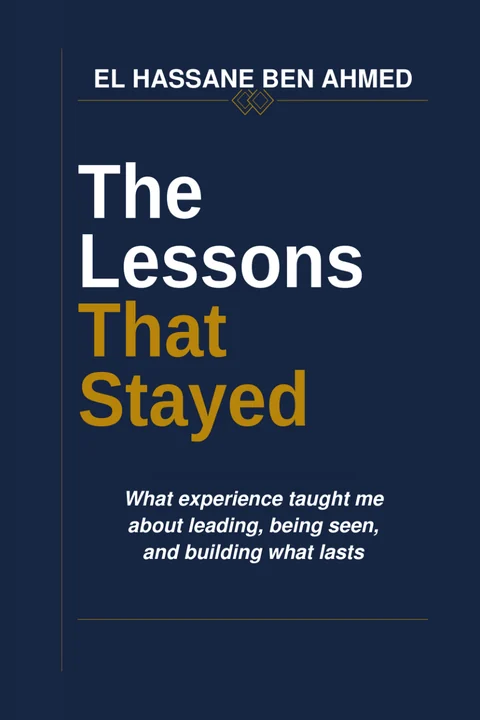
Clients fall into this trap without being naive, he writes in Chapter IV.4 of The Lessons That Stayed. The gap between the appearance of expertise and its substance has become unusually hard to judge: polished decks, confident language and AI-generated frameworks presented as proprietary insight. In case after case, the lower initial price produced a much higher eventual cost.
“What cheap consultants are selling is not consulting. It is an illusion of consulting, polished enough to pass initial scrutiny but too shallow to generate the outcomes it promises.”
The structure of the market
Management consulting has always occupied an ambiguous place in professional services. Unlike law or medicine, it has no licence and no single standard of competence. The book cites estimates that the global market is worth more than USD 300 billion a year. Growth, low barriers to entry and new tools have made the market for low-quality advice larger and more consequential than ever.
David Maister described two dimensions along which professional firms differ: customisation versus standardisation, and expertise versus efficiency. Firms competing on price are pushed toward standardised, efficient delivery, which is appropriate for routine problems and dangerous for complex ones.
The commoditisation trap
When clients choose consultants mainly on cost, high-quality providers face a choice: cut their prices, and with them the expertise those prices fund, or lose work to cheaper competitors.
Donald Schön distinguished technical rationality, applying established techniques to well-defined problems, from reflective practice, the ability to handle messy problems that do not fit any template. The problems organisations most need help with are almost always the second kind. Standardised, low-cost delivery is built for the first.
Information asymmetry and the market for lemons
Consulting fits this model closely. Valarie Zeithaml identified three kinds of quality cues buyers use: search qualities, which can be judged before purchase; experience qualities, which can only be judged afterwards; and credence qualities, which are hard to judge even after the fact. Most of what makes consulting valuable falls into the last two categories. Clients often only learn what they bought months later.
The hidden costs of cheap advice
The financial case for low-cost consulting looks simple: lower fees for nominally equivalent services. Frederick Reichheld and Earl Sasser showed that the full cost of poor service consistently exceeds its apparent cost, because the costs of failure are spread across time and departments in ways that hide their source. A failed implementation, a reorganisation that has to be undone, a strategy built on a wrong diagnosis: none of these appear on the consultant’s invoice.
Technology and the illusion of expertise
Generative AI can now produce strategic frameworks, market analyses, competitive assessments and implementation roadmaps in minutes, formatted with professional polish and apparent rigour. That makes polish nearly free, and it makes deliverables a poor signal of quality. Thomas Davenport and Julia Kirby argue that the most durable professional value in an AI-enabled world lies in contextual judgement: knowing which tools apply to a specific problem and how to interpret what they produce.
Where real consulting value comes from
The most important difference between high-quality and low-quality consulting, the chapter argues, is not the frameworks used. It is the quality of the diagnosis that comes before them. David Maister, Charles Green and Robert Galford describe the core of a trusted adviser as the ability to give genuinely independent counsel: to challenge the client’s own diagnosis and recommend what the evidence supports, even when it is uncomfortable.
How to choose a consultant
- Judge the questions, not the slides. In the first meetings, does the consultant ask about your situation in depth before offering solutions?
- Look for challenge. Have they disagreed with any part of how you described the problem? If not, ask them where they think you might be wrong.
- Ask who does the work. The senior person who sells the engagement is not always the person who delivers it.
- Test for context. Ask how their recommendation would change if one key fact about your organisation were different. Generic advice will not change.
- Price the failure, not only the fee. Estimate what it would cost if the diagnosis were wrong. That is the real number you are buying against.
- Be wary of instant frameworks. Polished material produced before anyone understands your problem is a warning sign, not a credential.
Value over price
Socrates was executed for asking questions that exposed the gap between real expertise and its performance. The path forward for clients, the chapter concludes, is to develop the judgement to look beyond surface credentials to the depth of engagement, the quality of questions and the willingness to challenge.
“Clients don’t need cheap advice. They need the right advice: the kind that actually moves the business forward. Cheap advice, as the evidence consistently shows, has a habit of becoming the most expensive mistake.”
Frequently asked questions
How can I tell a good consultant from a bad one?
Watch the first conversations. Good consultants ask probing questions about your actual problem before proposing anything, challenge your own diagnosis when the evidence warrants it, and are specific about what they do not know. Weak ones arrive with frameworks and answers.
Why is cheap consulting often more expensive?
Because the fee is only the visible part of the cost. Poor diagnosis leads to the wrong solution, failed implementation, lost time and decisions that have to be reversed. Those costs are spread across months and departments, so they rarely get attributed to the original choice.
Has AI changed the consulting market?
Yes. Generative AI can produce professional-looking strategies and analyses in minutes. That makes polish cheap and makes it harder for clients to judge quality from deliverables alone. What remains valuable is judgement about which tools apply to a specific situation.
What should I ask a consultant before hiring them?
What do you think our real problem might be, and what would you need to know to confirm it? What would make you tell us something we don’t want to hear? Who on your team will actually do the work?
Sources
This essay is adapted from Chapter IV.4 of The Lessons That Stayed by El Hassane Ben Ahmed (2026). Quotations are from the book.
- Maister, D.H. (1993) Managing the Professional Service Firm
- Schön, D.A. (1983) The Reflective Practitioner
- Akerlof, G.A. (1970) ‘The market for lemons’, Quarterly Journal of Economics
- Zeithaml, V.A. (1988) ‘Consumer perceptions of price, quality, and value’, Journal of Marketing
- Reichheld, F.F. and Sasser, W.E. (1990) ‘Zero defections’, Harvard Business Review
- Davenport, T.H. and Kirby, J. (2016) Only Humans Need Apply
- Maister, D.H., Green, C.H. and Galford, R.M. (2000) The Trusted Advisor
- Vaughan, D. (1996) The Challenger Launch Decision