Chapter I.5 · Recognition
When You Do Everything Right at Work and It Still Does Not Work
Sometimes the environment, not the effort, is the problem. How to tell persistence from denial, recognise structural incompatibility, and keep your standards when outcomes disappoint.
Key takeaways
- There are two different experiences that people confuse: a hard environment where effort will eventually pay off, and an environment that cannot recognise your kind of contribution however well you perform.
- Structural incompatibility shows up in three ways: an organisation that cannot hear bad news, one that rewards the wrong things, and one whose culture has passed a tipping point.
- Persistence and denial are not the same thing. Resilience is not stubbornness.
- Your standards are for building who you are, not only for producing outcomes. They travel with you.
- If you leave, leave with relationships intact, carry forward what you learned, and name the lesson rather than only the cost.
On this page
The project stays blocked. The organisation stays political. Leadership stays weak. Decisions remain inconsistent. Recognition never comes. The environment absorbs energy faster than results can appear.
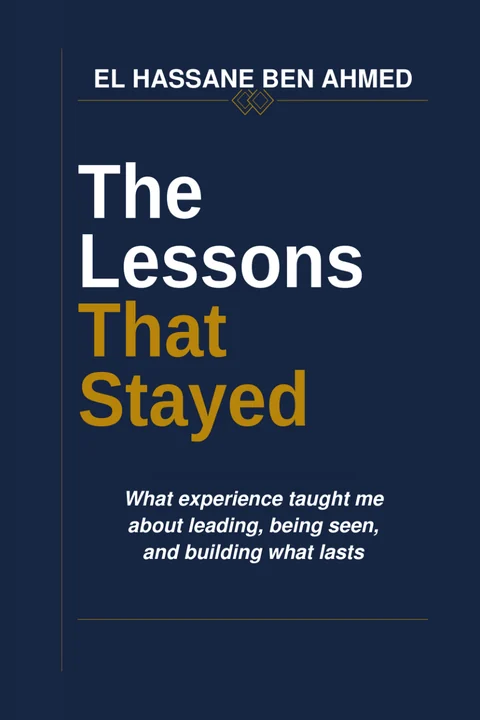
This is how Chapter I.5 of The Lessons That Stayed begins, and anyone who has worked inside a difficult organisation will recognise it. El Hassane Ben Ahmed calls this moment emotionally dangerous, because people start questioning themselves for problems that are structural, cultural or systemic. The internal story shifts from “this environment has a problem” to “I must have a problem”. That shift, he writes, is almost always wrong, and almost always costly.
Two experiences that get confused
The chapter starts from a distinction that most career advice ignores.
The first experience is working hard in a difficult environment where sustained effort will eventually produce results. Progress is slow, but it is real.
The second is working in an environment that is structurally incompatible with recognising the kind of contribution you make, however long you continue and however well you perform.
If you cannot tell these apart, you will make one of two mistakes. You will leave too early when persistence was right, or you will stay indefinitely when leaving was right.
How structural incompatibility shows up
The book describes three forms.
The organisation that cannot hear
Some organisations have information systems so distorted by political incentives that honest upward communication is effectively impossible. Bad news is filtered, softened or punished. However accurate your analysis, it never reaches the people who could act on it in a form they will accept.
The organisation that rewards the wrong things
Here, formal rewards and informal norms are misaligned with what you contribute. An organisation that claims to value rigour, honest challenge and long-term thinking while consistently rewarding political alignment, comfortable agreement and short-term output is telling you, through its behaviour, that your strengths are not what it actually wants.
The culture past its tipping point
The hardest to diagnose, because it happens gradually, is the organisation whose culture has deteriorated past the point where individual excellence can produce collective improvement. One person’s standards can lift a team in a healthy culture. In a culture past its tipping point, they are simply absorbed.
Persistence and denial are not the same thing
Resilience, in the sense that matters professionally, is not stubbornness. The chapter is careful on this point, because both look the same from the outside: someone who keeps going.
When persistence is no longer the right answer
- When the accumulated evidence shows the environment is structurally incompatible with what you offer.
- When the cost of continued effort exceeds the professional and personal resources you have to sustain it.
- When the opportunity cost of staying, the capability you are not building and the contribution you are not making elsewhere, has become significant.
None of these is decisive alone. Together, they are hard to argue with.
When persistence is still the right answer
Persistence remains right when the difficulty is real but the environment still responds to honest engagement, and when incompatibility has not yet been clearly established. Someone who leaves the moment difficulty arrives has not read the signals either.
Diagnosis needs both honesty and patience
The single most important discipline, according to the book, is evidence-based diagnosis rather than emotional conclusions. Write down what you have tried, what happened and what changed. Look at the pattern over months, not days. Talk to people who see the organisation from other angles.
What your standards are for
This is the heart of the chapter. A professional who maintains high standards only when those standards produce recognised outcomes is not showing discipline. They are showing a transaction.
The deeper function of standards in difficult environments, the book argues, is identity-building rather than outcome-producing. Composure, judgement, resilience and the discipline to keep standards without reward are capabilities that difficulty builds and ease does not. Carol Dweck’s work on mindset supports this: treating a hard environment as a place to develop those capabilities turns it into an investment rather than only an obstacle.
“Doing everything right does not always guarantee success immediately. But it still matters. Because discipline builds reputation. Consistency builds credibility. Professionalism builds long-term trust.”
How to leave without losing what you built
If the diagnosis says leave, the chapter offers three disciplines, drawing on Seneca’s view that the quality of a departure is as consequential as the quality of what came before.
Leave with relationships intact
The people you worked with in a difficult environment often know your value better than anyone. Protect those relationships. Do not burn the bridge on your way out, however tempting.
Carry the capabilities forward
Composure under pressure, judgement under uncertainty and resilience that comes from keeping standards without reward are real assets. Name them, and use them in the next role.
Name what you learned, not only what you endured
A story told only in terms of what an experience cost you is personally damaging and professionally counterproductive. The same experience told in terms of what it taught you is an asset in every interview and every future team.
Standards outlast environments
The central argument of the chapter is that the standards you keep during a difficult period do not disappear when the period ends. They become part of who you are, and they come with you.
Not every battle is meant to be won inside the same system. But whether you stay or leave, the author writes, what you carry out of the experience is determined by what you chose to be inside it.
“Even when outcomes disappoint you, your standards should not disappear with them. Persistence and denial are not the same thing.”
Frequently asked questions
Why is nothing working even though I’m doing everything right?
Sometimes because the environment is structurally incompatible with your contribution: it cannot hear honest information, it rewards politics over rigour, or its culture has deteriorated past the point where one person can change it. In those cases the problem is not your effort.
How do I know if I should keep going or give up?
Persistence still makes sense when the difficulty is real but the environment responds to honest engagement, and when incompatibility has not been clearly established. It stops making sense when the evidence of incompatibility accumulates, when the cost exceeds your resources, and when the opportunity cost of staying becomes significant.
Is leaving a sign of failure?
No. The book argues that not every battle is meant to be won inside the same system. What matters is the standard you keep and what you carry out of the experience.
How do I avoid blaming myself?
Separate the diagnosis from your identity. Ask what the evidence says about the environment before concluding something about yourself. The shift from “this environment has a problem” to “I must have a problem” is almost always wrong and almost always costly.
Sources
This essay is adapted from Chapter I.5 of The Lessons That Stayed by El Hassane Ben Ahmed (2026). Quotations are from the book.
- Hirschman, A.O. (1970) Exit, Voice, and Loyalty
- Dweck, C.S. (2006) Mindset
- Seneca, Letters
- Douglass, F. (1845) Narrative of the Life of Frederick Douglass