Chapter I.4 · Recognition
Should You Quit Your Job Without Another One Lined Up?
Sometimes the real reason to leave is quiet: your future is no longer being built where you are. A framework for deciding whether staying costs more than leaving, and how to exit well.
Key takeaways
- Most people wait for a dramatic reason to leave. The more common reason is quiet: influence shrinking, growth turning into repetition, accountability without authority.
- The usual question is “can I afford to leave?” The question that changes the decision is “can I afford to keep staying?”
- Weigh three costs: financial runway, reputational risk and developmental cost. The developmental one is the most often underestimated.
- Four signals justify serious consideration. Temporary difficulty and insufficient runway justify patience.
- How you leave matters as much as the decision to leave.
On this page
A senior executive once told El Hassane Ben Ahmed, calmly, that he was not unhappy. He had simply stopped moving forward.
The sentence stayed with the author, and it opens Chapter I.4 of The Lessons That Stayed. The executive was healthy, performing well and respected on paper. Good salary, strong title, stable life. From the outside there was no reason to leave. Inside, something had changed. His work was still valuable, but his influence was shrinking. Decisions were made around him rather than with him. He kept the accountability and lost the authority. Meetings had become updates instead of conversations. He was not burned out. He was becoming professionally invisible.
The reason nobody talks about
Most professionals wait for a dramatic reason to leave: a crisis, a conflict, a toxic manager. The reason that matters more often is much quieter.
“Many people wait for a dramatic reason to leave. But sometimes the real reason is quieter. You leave because your future is no longer being built there.”
What professional invisibility looks like
The chapter describes a condition that is easy to feel and hard to name.
Accountability without authority
The most difficult form to put into words is the slow reversal of the relationship between responsibility and power. You are still accountable for outcomes, but the decisions that shape them are taken elsewhere. You carry the risk without the control.
Growth turned into repetition
Career researcher Douglas Hall distinguishes positions that build capability from positions that consume it. In the first kind, each year leaves you more capable. In the second, you repeat the same year with a higher number of years of experience on your CV.
A cost that accumulates quietly
The most dangerous feature of professional invisibility is that it is invisible. There is no single bad day to point to. The cost compounds slowly: skills that are not developed, networks that are not built, opportunities that pass without you noticing.
The question that changes the calculation
When people think about leaving without another job in hand, they ask: can I afford to leave? That question matters. But the chapter argues that a second question changes the decision when it is asked honestly: can I afford to keep staying?
The financial calculation
Be honest about runway: how long you can search without financial distress, and how long searches realistically take at your level and in your field. Add a margin. If the numbers do not work, that is a real reason to wait, not a lack of courage.
The reputational calculation
The reputational risk of leaving without a role lined up has changed a great deal over the past decade. Non-linear careers are more common and better understood. A gap you can explain clearly is far less damaging than many people fear.
The developmental calculation
This is the one people most often underweight. Every year in a role that consumes your capability is a year of development you do not get back. Compare where you will be in two years if you stay with where you could be if you leave. The difference is the real price of staying.
Signals that justify serious consideration
The decision deserves serious thought when several of these converge:
- Your influence has contracted over a sustained period, not just for a difficult quarter.
- The role consumes your capability rather than building it.
- Sustained effort no longer produces the recognition or advancement that would justify continued investment.
- Your trajectory is narrowing: fewer options, fewer skills in demand, fewer people who know what you can do.
Signals that justify patience
The decision deserves patience when the conditions above are temporary rather than structural, when there is a credible reason to believe they will change, when the role is still building capability despite its frustrations, or when your financial runway is not sufficient for the search a principled exit would require. Patience in these conditions is not weakness. It is judgement.
Leaving well
The quality of the exit matters as much as the decision. A good exit:
- is planned, with a clear timeline and a handover that protects the people who stay;
- keeps relationships intact, because the people you worked with will remain part of your professional network;
- is explained simply and without bitterness, to colleagues and later to recruiters;
- is followed by a deliberate search, not a panicked one.
What happened to the executive
The executive whose sentence opened the chapter eventually left. He later described it as one of the clearest decisions he had ever made.
The lesson the author draws is not that professionals should be impatient with difficulty or quick to leave when things get hard. Most difficulty is worth working through. The lesson is narrower and more useful: when your future has stopped being built where you are, the comfort of staying is not free.
“Sometimes the boldest career move is not accepting the next offer. It is refusing to remain where your future is slowly getting smaller.”
Questions to ask yourself
- Over the past year, has my influence grown, stayed the same or shrunk?
- Am I learning things that make me more valuable, or repeating what I already know?
- If nothing changes, where will I be in two years? Is that acceptable?
- How long could I search without financial stress, and how long do searches really take in my field?
- Have I genuinely tried voice, raising the issue and proposing changes, before choosing exit?
Frequently asked questions
Is it a bad idea to quit without another job lined up?
Not automatically. It depends on your financial runway, the realistic length of your search and, most importantly, what staying is costing your development. For some people it is reckless. For others it is the clearest decision they will make.
What are the signs it is time to leave?
Influence that has shrunk over a sustained period, a role that consumes your capability instead of building it, effort that consistently fails to bring recognition or advancement, and a career trajectory that is narrowing rather than widening.
How much savings do I need before quitting?
Enough to cover a realistic search period without financial distress. Estimate how long searches take at your level in your field, add a margin, and be honest about it. Insufficient runway is a reason for patience.
Will a gap on my CV hurt me?
Less than it used to. Employers now see many non-linear careers. A gap you can explain clearly, with what you did and learned, is far less damaging than years of stagnation.
Sources
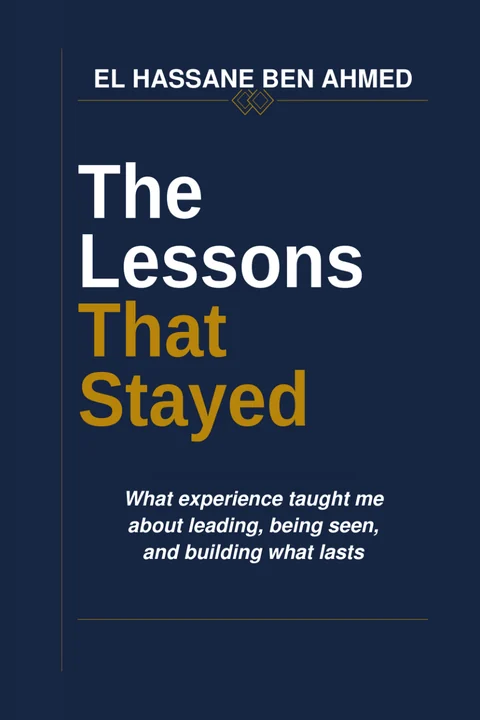
This essay is adapted from Chapter I.4 of The Lessons That Stayed by El Hassane Ben Ahmed (2026). Quotations are from the book.
- Seneca, On the Shortness of Life
- Hirschman, A.O. (1970) Exit, Voice, and Loyalty
- Hall, D.T. (2002) Careers In and Out of Organizations
- Mill, J.S. (1859) On Liberty