Chapter I.1 · Recognition
Why Good Work Goes Unnoticed, and How to Make Your Contribution Visible
Excellent work does not always speak for itself. Why contribution becomes invisible inside organisations, and the practical habits that make it visible without self-promotion.
Key takeaways
- Organisations do not record contribution neutrally. Who did what is filtered through relationships, meetings and stories, so unmanaged work tends to become invisible.
- Invisibility is usually structural, not personal. It comes from hierarchy, distance from decision-makers and information that travels upward without names attached.
- The fix is not working harder. It is documenting impact, communicating progress to the right people and building relationships across groups.
- The ethical standard is accuracy: making sure people’s impression of your contribution matches what you actually did, no more and no less.
On this page
Most professionals start their careers with a simple belief: do excellent work and the recognition will follow. It is a reasonable belief. Without real performance, no amount of visibility produces a lasting career. But it is incomplete, and the missing part can quietly cost people years.
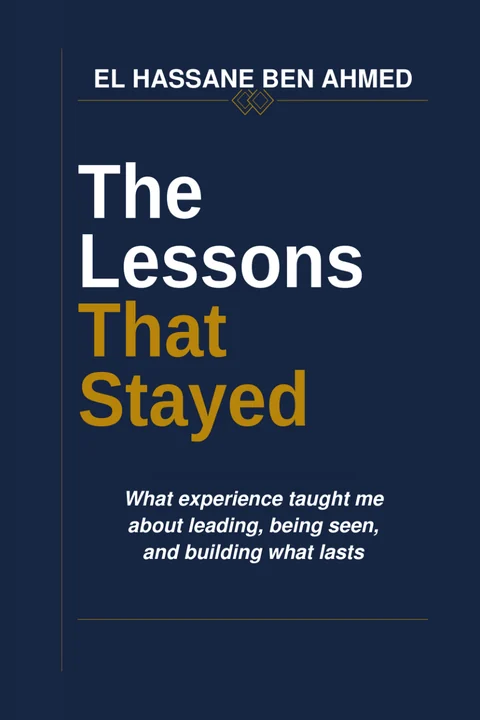
In The Lessons That Stayed, El Hassane Ben Ahmed opens the book with this exact problem. Early in his career he worked with a leader whose quiet talent was that every success, whoever had driven it, found its way back to him in the telling. There was no confrontation and no obvious scheming. Stories simply changed shape as they travelled from one room to another. The work was real. The credit went elsewhere.
This article sets out why that happens, why it is rarely about malice, and what you can do so that the value you create is also the value people see.
Why doesn’t good work speak for itself?
Because organisations are not neutral recording devices. They are social systems. Information about who did what is filtered, interpreted and attributed through layers of relationships, perceptions and stories. Those stories are shaped as much by visibility as by reality.
The book puts it in one line:
“Value is not only created but also narrated. If you are absent from that narrative, your contribution can quietly disappear, not because of malice, but because invisibility is the default condition of unmanaged work.”
That last phrase matters. Invisibility is the default. Nobody has to take your work for it to disappear. It is enough that nobody carries your name along with it.
How does contribution become invisible?
The chapter is clear that deliberate misattribution happens, but it is not the main cause. Most invisibility comes from mechanisms that operate beneath conscious awareness and that are built into the way most organisations share information.
Visibility flows upward with the work
In a hierarchy, work moves up the chain and visibility moves with it. Rosabeth Moss Kanter documented this pattern in the 1970s, and it has not gone away. A report written by an analyst becomes the manager’s slide, then the director’s recommendation. At each step the work gets closer to the people who make decisions, and the original author gets further away from them.
The proximity gradient
The book describes a proximity gradient: the perceived value of someone’s contribution declines as the distance between the contributor and the observer grows. Senior leaders see the people who are in the room with them. For most professionals in large organisations, the default condition is to be invisible to exactly the people whose opinions most affect their careers.
Stories are told in rooms you are not in
Organisations make sense of events through narrative, as Karl Weick showed. Someone explains what happened, why it worked and who made the difference. Those explanations are built in specific forums: leadership meetings, project reviews, hallway conversations after a presentation. If you are not in those forums when your work is discussed, you depend on someone else’s account of it, filtered through their perspective, their interests and their memory.
Benjamin Disraeli, whom the book also discusses, understood this better than most of his contemporaries. He treated reputation as a social construction built from many impressions over time. Managing it was not vanity to him. It was part of the work.
What actually makes work visible?
The answer is not to work longer hours or to become louder in meetings. The chapter draws on organisational research to describe a small set of practical habits.
1. Document impact, not tasks
This is the single most consequential change most professionals can make. Compare two ways of describing the same work:
- “I produced the quarterly analysis.”
- “I identified a cost inefficiency in the quarterly analysis that enabled a twelve per cent reduction in operating expense.”
The first is a task. The second is a value claim that a decision-maker can remember and repeat. Keep a running written record of decisions you influenced, problems you solved and the outcomes that followed. When performance reviews, promotions or project assignments come up, that record is evidence rather than recollection.
2. Communicate progress to the people who need to know
Herminia Ibarra and Mark Hunter found that effective professionals manage the visibility of their work on purpose. They send short progress notes to stakeholders, frame their contribution explicitly and do not assume it will be inferred. This does not mean copying the whole company on every email. It means making sure the people who evaluate your work hear about it from you, accurately, before they hear a version of it from someone else.
3. Build relationships across groups
Ronald Burt’s research on “structural holes” shows that people who connect otherwise separate groups are both more visible and better able to influence how credit flows. If your network is only your immediate team, your work reaches decision-makers through one channel. If you have working relationships with peers in other functions, your contribution has more than one route to the people who matter.
Isn’t this just self-promotion?
Many conscientious people resist visibility because it feels like bragging. The book answers this with Aristotle. In the Nicomachean Ethics, Aristotle treated excessive self-promotion as a vice, but he treated excessive self-deprecation as a vice too. The virtue sits in between: accurate representation, telling the truth about yourself, no more and no less.
Seen this way, making your work visible is not a favour you do for yourself. It is information the organisation needs to allocate opportunities fairly. When you understate what you did, you are not being humble. You are giving decision-makers a distorted picture, and the distortion usually benefits whoever is most comfortable talking about themselves.
The test is simple: after people hear your account, is their impression of your contribution closer to the truth or further from it?
What changed for the author
Ben Ahmed describes the shift he eventually made. It was not about working harder or performing differently. It was about dropping the assumption that good work would find its own audience. He started documenting decisions and outcomes, sharing progress with the people who needed it, and making sure his contribution was described in terms of its effect.
Over time, recognition depended less on one person’s lens and more on shared facts. That is the real goal of visibility: not to be talked about more, but to make the record of your work hard to rewrite.
“Doing great work is non-negotiable, but making your contribution visible is what protects it.”
A short checklist
- Keep a weekly log of decisions you influenced and their outcomes, written in terms of impact.
- Before any review or promotion discussion, turn that log into three or four clear value statements.
- Send brief progress updates to the people who evaluate your work, especially when you are not in the meetings where it is discussed.
- Build at least one working relationship outside your immediate team each quarter.
- When someone else presents work you contributed to, add the specifics yourself, calmly and factually.
- Ask yourself whether people’s picture of your work is accurate. If it is not, correct it with facts rather than frustration.
Visibility will not fix every environment. Some organisations are built so that certain people’s work is never seen, and later chapters of the book deal with that harder case. But in most workplaces, the gap between the value you create and the value people see is partly within your control. Closing it is not vanity. It is how good work survives.
Frequently asked questions
Why does my good work go unnoticed?
Usually because organisations do not record contribution automatically. Information about who did what travels through managers, meetings and informal conversations. If you are not part of those channels, your work can be absorbed into someone else’s account of it, often without any bad intention.
Is making my work visible the same as self-promotion?
No. The useful standard is accuracy. Self-promotion overstates what you did. Visibility makes sure decision-makers have a correct picture of it. Understating your contribution is also a distortion, because it gives the people who allocate opportunities wrong information.
What is the simplest habit that improves visibility?
Describe impact rather than tasks. “I produced the quarterly analysis” records an activity. “I found a cost inefficiency in the quarterly analysis that led to a twelve per cent reduction in operating expense” shows the value of the same work.
Which chapter of The Lessons That Stayed covers this topic?
Chapter I.1, “The Lesson I Learned About Visibility”, the opening chapter of Part I: Recognition.
Sources
This essay is adapted from Chapter I.1 of The Lessons That Stayed by El Hassane Ben Ahmed (2026). Quotations are from the book.
- Kanter, R.M. (1977) Men and Women of the Corporation
- Weick, K.E. (1995) Sensemaking in Organizations
- Ibarra, H. and Hunter, M. (2007) ‘How leaders create and use networks’, Harvard Business Review
- Burt, R.S. (2004) ‘Structural holes and good ideas’, American Journal of Sociology