Chapter IV.1 · Performance
The Complete Leader: How Empathy, Strategy and Authenticity Work Together
Effective leaders do not master one style. They hold several at once. How empathy, strategic clarity and authenticity combine into secure-base leadership, with four practical disciplines.
Key takeaways
- The most effective leaders do not master one style. They hold several at once and choose the right register for the moment.
- Empathy is a disciplined capability, not softness. It is the foundation of psychological safety.
- Strategy, for a leader, means clarity: knowing what matters, saying it plainly and protecting the team’s focus.
- Authenticity rests on self-awareness, transparency, balanced judgement and consistency over time.
- Together they create a “secure base”: an environment safe enough that challenge becomes productive rather than threatening.
On this page
- The myth of the single-style leader
- Empathy: a discipline, not a softness
- Strategy: the architecture of clarity
- Authenticity: the courage to lead truthfully
- The secure base: where the three meet
- Psychological safety in practice
- Leading under pressure
- Four practical disciplines
- How this kind of leadership develops
- The leadership no framework can teach
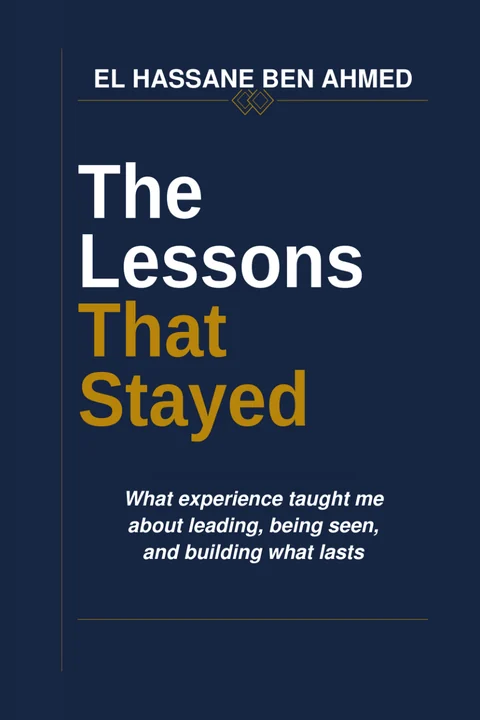
“I didn’t set out to study leadership,” El Hassane Ben Ahmed writes at the start of Chapter IV.1 of The Lessons That Stayed. “I set out to lead, and the study came from the failures.”
From moments when he thought he was being decisive and later discovered he had simply been loud. From times he believed he was building trust and later realised he had only been building compliance. From assignments in new countries where a playbook he had trusted for years produced nothing but confusion.
The framework in this chapter, empathy, strategy and authenticity, did not arrive as a theory. It arrived as a pattern he kept noticing in the leaders who actually got results over time, as opposed to those who simply moved things around for a season. It is the longest chapter in the book, and in many ways its centre.
“The most effective leaders are not those who have mastered one style but those who can hold several at once, choosing the right register for the right moment.”
The myth of the single-style leader
For much of the twentieth century, leadership was described as a matter of style: transformational or transactional, directive or participative. The implication was that you find your style and get better at it. Experience suggests otherwise.
Empathy: a discipline, not a softness
Empathy is often dismissed as soft or confused with sympathy. The chapter treats it as a hard capability: the disciplined effort to understand how a situation looks from someone else’s position.
Empathy and psychological safety
Amy Edmondson’s research found that psychological safety, the shared belief that a team is safe for interpersonal risk, is the strongest single predictor of team learning and performance. Empathy is how leaders build it. When leaders listen without judgement and respond with genuine care, they signal that each person is valued as a human being and not only as a resource.
Active listening
Carl Rogers and Richard Farson described active listening as deliberate, non-judgemental attention to what someone communicates in words, tone, posture and silence. Its hardest part is resisting the urge to solve before you have understood. Mandela’s biographers describe a leader who was often the last to give his opinion in a meeting, because he knew his judgement depended on the quality of what he heard first.
Strategy: the architecture of clarity
Strategy in leadership is not only corporate planning. It is the work of knowing what matters, saying it clearly, and keeping the team pointed at it.
Clarity as a form of care
People cannot do good work when they do not know what good looks like. A leader who sets clear direction, explains priorities and makes trade-offs explicit is not being controlling. They are removing uncertainty that would otherwise drain the team’s energy.
Adaptive strategy
Ronald Heifetz and colleagues distinguish technical problems, which existing expertise can solve, from adaptive challenges, which require new learning. Eisenhower’s handling of a fractious alliance was an adaptive challenge, and he treated it as one: he learned, adjusted and kept the coalition intact.
Protecting focus
One of leadership’s primary strategic functions is protecting the team’s attention from competing demands. Eisenhower was known as much for what he chose not to attend to as for what he did.
Authenticity: the courage to lead truthfully
Fred Walumbwa and colleagues identified four components of authentic leadership:
- Self-awareness: knowing your strengths, limits and effect on others.
- Relational transparency: being open about your thinking and your mistakes.
- Balanced processing: seeking out views that challenge your own before deciding.
- Internalised moral perspective: acting from your values even under pressure.
Brené Brown adds that authenticity requires the willingness to admit uncertainty and acknowledge mistakes without losing your footing. And in the end it depends on consistency: whether values, words and actions line up over time and across contexts.
The secure base: where the three meet
George Kohlrieser’s secure-base model, set out in Care to Dare, offers the framework that ties the chapter together. Drawing on John Bowlby’s attachment theory, it describes leaders who provide enough safety that people are willing to take risks and grow. Kohlrieser identifies four functions: providing safety and trust, acceptance and value, expansion and growth, and direction and vision. Empathy supplies the first two. Strategy supplies the last. Authenticity makes all of it believable.
“The secure-base leader doesn’t protect people from challenge. They ensure that the relational environment is safe enough to make challenge productive rather than threatening.”
Psychological safety in practice
Peter Drucker spent six decades observing that the quality of a decision depends on the quality of information reaching the decision-maker, and that the quality of information depends on whether people feel safe enough to share it. Edmondson later gave that observation a name and the evidence to support it. Google’s Project Aristotle, which studied 180 teams, found psychological safety to be the most important factor in team effectiveness, ahead of individual talent and resources.
Leading under pressure
Pressure creates a paradox: the conditions that most demand integrated leadership are the ones most likely to trigger behaviour that undermines it.
The chapter’s conclusion on this point is direct: calm and clarity are leadership deliverables, not personality traits.
Four practical disciplines
- Hold the base steady. Keep relational stability and psychological safety intact when external pressure rises. Pay attention to what the environment is telling you and adjust, which Follett called “circular response”.
- Encourage challenge and ownership. Create conditions where people exercise real authority over work they genuinely own. Ask for disagreement, and reward it.
- Communicate with clarity and honesty, especially when honesty is uncomfortable. Lincoln, Mandela, Churchill, Eisenhower and Marshall all held this discipline in common.
- Model the culture you want. Leaders do not simply manage culture. They are its most visible example.
How this kind of leadership develops
None of the leaders in the chapter developed these capabilities through workshops. They developed them through experience, failure, reflection and deliberate practice. For organisations, that has implications: selection and promotion criteria should look for evidence of all three dimensions, and structures should give leaders the space and feedback to grow them.
The leadership no framework can teach
Lincoln once said he did not claim to have controlled events, but confessed plainly that events had controlled him. What he, Mandela, Eisenhower, Churchill, Marshall, Seneca, Drucker and Follett share is not a common style. It is a willingness to keep learning, combined with values that did not bend to convenience.
“Leadership is not about being the complete answer. It’s about creating the conditions in which complete answers become possible.”
Frequently asked questions
What are the three dimensions of complete leadership?
Empathy (understanding and valuing people), strategy (clarity about direction and priorities) and authenticity (alignment between values, words and actions). The book argues that effective leadership depends on integrating all three rather than excelling at one.
What is secure-base leadership?
A model developed by George Kohlrieser and colleagues: the leader provides enough safety and trust that people are willing to take on challenge, risk and growth. The leader does not protect people from difficulty but makes difficulty manageable.
What is authentic leadership?
Research by Fred Walumbwa and colleagues identifies four components: self-awareness, relational transparency, balanced processing of information and an internalised moral perspective.
Can these qualities be learned?
Yes, though rarely in a workshop alone. The leaders examined in the book developed them through experience, reflection and deliberate practice, often after their own failures.
Sources
This essay is adapted from Chapter IV.1 of The Lessons That Stayed by El Hassane Ben Ahmed (2026). Quotations are from the book.
- Edmondson, A.C. (1999) ‘Psychological safety and learning behavior in work teams’, Administrative Science Quarterly
- Rogers, C.R. and Farson, R.E. (1957) Active Listening
- Heifetz, R., Grashow, A. and Linsky, M. (2009) The Practice of Adaptive Leadership
- Walumbwa, F.O. et al. (2008) ‘Authentic leadership’, Journal of Management
- Brown, B. (2018) Dare to Lead
- Kohlrieser, G., Goldsworthy, S. and Coombe, D. (2012) Care to Dare
- Bowlby, J. (1969) Attachment and Loss
- Follett, M.P. (1924) Creative Experience