Chapter II.1 · Culture
Fear-Based Leadership: Why Intensity Is Not Impact
Shouting, public criticism and pressure can move numbers in the short term. The evidence shows they destroy the trust and psychological safety that real performance depends on.
Key takeaways
- Fear produces movement, not performance. Compliance and commitment look identical in the short term and very different over time.
- Fear-based leadership destroys psychological safety first, which research identifies as the strongest predictor of team learning and performance.
- Under threat, the brain prioritises self-protection over thinking. Frightened teams make fewer good decisions, not more.
- Trust in leadership is consistently linked to performance. A meta-analysis of 106 studies with more than 27,000 people found the link across many outcomes.
- High standards and dignity are not opposites. The alternative to fear is not softness. It is composed authority.
On this page
Early in his career, El Hassane Ben Ahmed worked in environments that equated volume with authority. He watched leaders raise their voices, criticise people in public and use demeaning remarks to show that standards mattered. The numbers moved. Deadlines were met. On the surface, it worked.
Beneath the surface, something was eroding. People spoke less. They focused on avoiding mistakes rather than creating value. The most capable colleagues, those with the most to offer, began to leave. The damage only became visible later, when initiative faltered, candour disappeared, and what remained was compliance dressed up as performance.
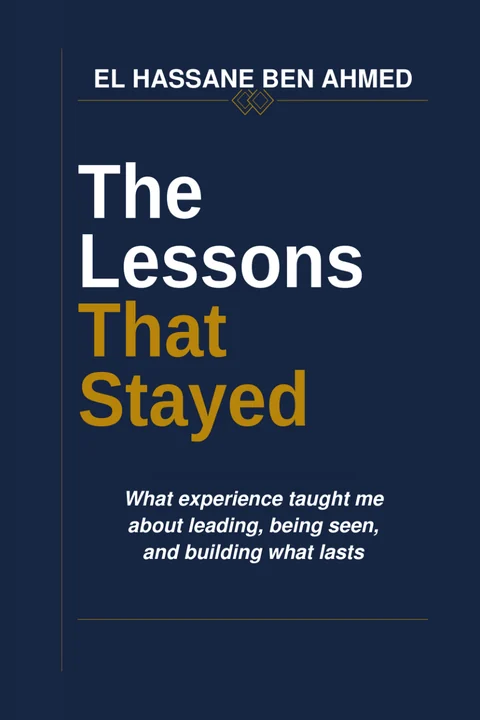
Chapter II.1 of The Lessons That Stayed is about that gap between intensity and impact.
“Fear produces movement but not performance. Compliance and commitment look similar in the short term. They are completely different over time.”
The illusion of control through pressure
In many organisations, people mistake intensity for effectiveness. Loud meetings look decisive. Public reprimands look like high standards. Pressure looks like drive. What these behaviours reliably produce is activity. What they do not produce is the kind of performance that lasts.
What fear destroys
Organisational researcher Blake Ashforth described petty tyranny: using positional authority to dominate through arbitrary decisions, public criticism, belittling, unpredictable punishment and active discouragement of initiative. Each of these behaviours sends the same message to a team. Speaking up is dangerous.
Psychological safety, the belief that a team is safe for interpersonal risk, is the factor Edmondson identified as the strongest predictor of team learning and performance. It is also, by definition, the first thing fear-based leadership destroys. People who are afraid stop reporting problems early, stop proposing ideas, and stop challenging decisions that are likely to fail.
What happens in a frightened brain
The chapter draws on neuroscience to explain why fear and good thinking do not coexist.
David Rock’s SCARF model describes five social domains that the brain evaluates as threat or reward: status, certainty, autonomy, relatedness and fairness. Public humiliation threatens status. Unpredictable reactions threaten certainty. Micromanagement threatens autonomy. A leader who triggers all five at once is putting the team into a permanent defensive state. Daniel Goleman called the extreme version an amygdala hijack: strong emotion overriding deliberate thought. Frightened people do not make better decisions. They make faster, narrower, safer ones.
Compliance versus commitment
Edward Deci and Richard Ryan’s self-determination theory distinguishes two kinds of motivation. External regulation is behaviour driven entirely by reward or the avoidance of punishment. Intrinsic motivation is behaviour driven by genuine interest, ownership and belief in the work. Fear produces the first. Lasting performance needs the second.
The evidence for trust
The book brings together a body of evidence that points in one direction.
- Trust predicts performance. Kurt Dirks and Donald Ferrin’s meta-analysis of 106 studies, covering more than 27,000 participants, found a consistent positive relationship between trust in leadership and outcomes that matter for performance.
- Psychological safety distinguishes the best teams. Google’s Project Aristotle found it to be the most important factor separating its highest-performing teams from its lowest, above individual talent and resources.
- The best leaders are not the loudest. Jim Collins expected his Good to Great research to identify charismatic, forceful executives. He found almost the opposite: leaders who combined personal humility with intense professional will.
Accountability without humiliation
None of this means lowering standards. The chapter is clear that the alternative to fear is not softness.
Brené Brown argues that accountability and dignity reinforce each other: a leader who holds people to account with clarity, specificity and respect creates the conditions in which people can actually improve. Kim Scott’s “radical candour” makes the same point in practical terms: challenge directly while caring personally.
In practice, accountability without humiliation looks like this:
- Be explicit about the standard before the work starts, not only after it falls short.
- Address performance specifically and privately. Name what happened and what needs to change.
- Separate the work from the person. Criticise the output, not the worth of the individual.
- Follow through consistently. Standards that are enforced only when the leader is angry are not standards.
- Give credit publicly, and make sure it lands on the right people.
Composure as competence
Frederick the Great built compliance. Scharnhorst and Gneisenau built commitment. History judged between them at Jena and in the years that followed.
The leaders Ben Ahmed observed who got this right, who kept high standards without generating fear, shared a quality he calls composed authority. They were demanding and calm at the same time. Their teams knew exactly what was expected and felt safe telling them the truth.
“Leadership is not about being the loudest voice in the room. It is about maintaining composure when it matters most. Sustainable results stem from trust, clarity, and consistency, not from fear.”
Questions for leaders
- When something goes wrong on your team, do you hear about it early or late?
- When did someone last disagree with you in a meeting?
- Are your best people staying, or are the ones with options quietly leaving?
- If you removed the pressure tomorrow, would the work continue at the same standard?
Frequently asked questions
Does fear-based leadership work?
In the short term it can make numbers move and deadlines get met. Over time it drives out the most capable people, kills candour and initiative, and leaves an organisation that only functions under observation.
What is psychological safety?
A shared belief that a team is safe for interpersonal risk: that people can raise mistakes, questions and concerns without being punished or humiliated. Amy Edmondson’s research found it to be the strongest predictor of team learning, and Google’s Project Aristotle found it to be the factor that most distinguished its best teams.
How can a leader hold people accountable without fear?
By being clear and specific about expectations, addressing performance directly and privately, and keeping respect for the person intact. Brené Brown and Kim Scott both describe accountability and dignity as mutually reinforcing.
What should I do if my manager leads through fear?
Protect your judgement and your health, keep written records, find allies who share your standards, and be honest with yourself about whether the environment can change. Fear-based cultures rarely change from below.
Sources
This essay is adapted from Chapter II.1 of The Lessons That Stayed by El Hassane Ben Ahmed (2026). Quotations are from the book.
- Ashforth, B. (1994) ‘Petty tyranny in organizations’, Human Relations
- Edmondson, A.C. (1999) ‘Psychological safety and learning behavior in work teams’, Administrative Science Quarterly
- Edmondson, A.C. (2019) The Fearless Organization
- Rock, D. (2008) ‘SCARF’, NeuroLeadership Journal
- Goleman, D. (1995) Emotional Intelligence
- Deci, E.L. and Ryan, R.M. (1985) Intrinsic Motivation and Self-Determination in Human Behavior
- Collins, J. (2001) Good to Great
- Dirks, K.T. and Ferrin, D.L. (2002) ‘Trust in leadership’, Journal of Applied Psychology
- Brown, B. (2018) Dare to Lead
- Scott, K. (2017) Radical Candor