Chapter II.2 · Culture
Leading Across Cultures: Why Your Leadership Playbook Does Not Travel
Expatriate and international leaders often find that what worked at home fails abroad. How cultural intelligence turns a fixed leadership style into an adaptable toolkit.
Key takeaways
- Leadership approaches that work at home often produce different, disappointing results in another culture. The quality of your work does not change; how it is received does.
- Cultures differ on dimensions such as power distance and directness, which change what decisiveness, respect and trust look like.
- Effective international leaders make four shifts: from expert to apprentice, from directive to dialogic, from title to trust, and from fixed style to flexible toolkit.
- Cultural intelligence has four parts: awareness of your own assumptions, knowledge, motivation and adapted behaviour.
- Adapting is not abandoning who you are. Your values stay; your expression of them changes.
On this page
El Hassane Ben Ahmed arrived on his first international assignment confident in his playbook. He had years of experience, a solid track record and an approach he had tested and refined in places where it consistently worked. Within a few months he discovered that the playbook did not travel.
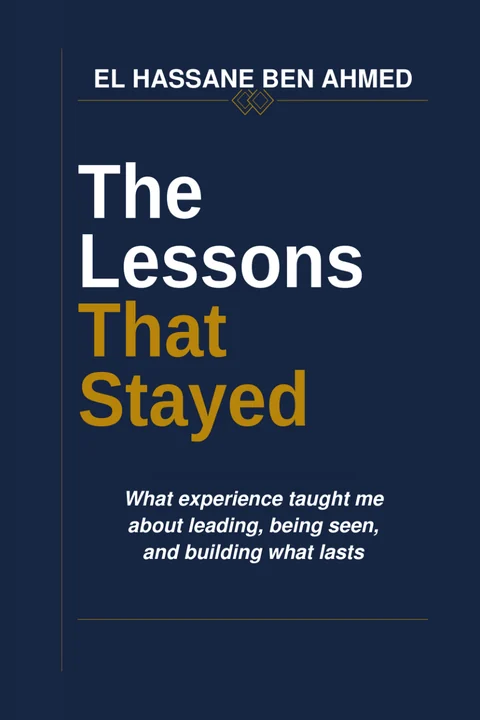
The approach that signalled decisiveness at home came across as arrogance in one context and indifference in another. The quality of his work had not changed. His assumption about how it would be received had. Chapter II.2 of The Lessons That Stayed grew out of that gap, and out of three decades of leading teams in ten countries across Africa, the Middle East and South Asia.
“The most effective leadership style is not one that is pre-packaged but one that is built through humility, curiosity, and genuine adaptation to a new environment.”
Why leadership does not travel unchanged
Every leadership behaviour is a signal, and every culture reads signals differently. Geert Hofstede’s research identified dimensions along which national cultures vary, several of which bear directly on leadership:
- Power distance: how far people expect and accept unequal distribution of authority.
- Individualism and collectivism: whether identity and loyalty centre on the individual or the group.
- Uncertainty avoidance: how comfortable people are with ambiguity and unstructured situations.
Edward T. Hall added the distinction between low-context and high-context communication. In low-context cultures, meaning is carried mainly by explicit words. In high-context cultures, much of the meaning sits in relationships, tone, timing and what is left unsaid. A direct instruction that sounds confident in one context can sound careless or disrespectful in another.
The four shifts of effective international leaders
The chapter organises the transformation into four movements.
1. From expert to apprentice
Your expertise in your field does not shrink when you cross a border. What changes is your knowledge of how that expertise turns into results in a new environment. Ronald Heifetz and colleagues distinguish technical problems, solvable with existing knowledge, from adaptive challenges, which require new learning. Leading in a new culture is an adaptive challenge.
Cultural humility means recognising that your own framework is not universal, that it has strengths and blind spots, and that understanding a new context requires suspending your assumptions long enough to see what is actually there.
2. From directive to dialogic
In many contexts, leadership that tells is less effective than leadership that asks. Physicist and thinker David Bohm argued that real dialogue requires suspending fixed positions long enough to genuinely consider other perspectives.
3. From title to trust
In cultures with high power distance, positional authority may be respected as a social norm, but respect for the title is not the same as trust in the person. Roger Mayer, James Davis and David Schoorman identify three components of trust: belief in the leader’s competence, belief in their genuine regard for others’ interests, and belief in their integrity. All three have to be demonstrated, and what demonstrates them varies by culture.
4. From style to toolkit
Christopher Earley and Soon Ang’s concept of cultural intelligence describes the capability that makes this possible. It has four parts:
- Metacognitive: awareness of your own cultural assumptions as you act.
- Cognitive: knowledge of how other cultures work.
- Motivational: the drive and confidence to adapt.
- Behavioural: the ability to actually change how you speak and act.
Peter Northouse describes the result as the difference between leadership essence and leadership expression. Your values, purpose and standards are the essence, and they travel. Your communication style, decision-making process and ways of showing respect are the expression, and they must adapt.
Aristotle made a similar point in the Rhetoric. He named three modes of persuasion, reason (logos), character (ethos) and emotion (pathos), and argued that none is always superior. The effective speaker chooses according to the audience.
Practical starting points
- Spend your first weeks asking more than telling. Ask how decisions are really made, not only how they are supposed to be made.
- Find two or three trusted local colleagues who will tell you honestly how your behaviour is being read.
- Watch how respected local leaders give feedback, disagree and make decisions. Notice what they do not say.
- Separate your non-negotiables (values, ethics, quality) from your habits (tone, pace, formality). Adapt the habits freely.
- Expect to be wrong, and treat each misreading as information rather than failure.
Leadership as continuous adaptation
Ricci, Machiavelli, de Gaulle, Gandhi and Mandela each went through what the chapter calls a style-to-toolkit transformation. None of them became someone else. Each learned that the same convictions needed different expressions in different places.
The lesson that stayed from Ben Ahmed’s first international assignment was not a piece of cultural knowledge. It was a change in how he understood leadership itself.
“Expatriation doesn’t merely add international experience to a leadership profile. It rewires the assumptions about authority, influence, and identity on which that profile is built.”
Frequently asked questions
Why doesn’t my leadership style work in another country?
Because the signals you send are read through a different cultural lens. Directness that reads as decisive in one culture can read as arrogant or careless in another. Authority that comes from a title in one place has to be earned through behaviour in another.
What is cultural intelligence (CQ)?
A concept developed by Christopher Earley and Soon Ang: the capability to work effectively across cultures. It combines awareness of your own cultural assumptions, knowledge of other norms, the motivation to adapt, and the ability to change your behaviour accordingly.
Do I have to change who I am to lead abroad?
No. The useful distinction is between leadership essence (your values and purpose) and leadership expression (how you communicate and act). The essence travels. The expression has to adapt.
What is the first thing to do in a new cultural context?
Listen before acting. Treat your first months as an apprenticeship: ask how decisions are really made, who people trust and why, and what respect looks like here.
Sources
This essay is adapted from Chapter II.2 of The Lessons That Stayed by El Hassane Ben Ahmed (2026). Quotations are from the book.
- Hofstede, G. (2001) Culture’s Consequences
- Hall, E.T. (1976) Beyond Culture
- Heifetz, R., Grashow, A. and Linsky, M. (2009) The Practice of Adaptive Leadership
- Bohm, D. (1996) On Dialogue
- Mayer, R.C., Davis, J.H. and Schoorman, F.D. (1995) ‘An integrative model of organizational trust’, Academy of Management Review
- Earley, P.C. and Ang, S. (2003) Cultural Intelligence
- Northouse, P.G. (2021) Leadership: Theory and Practice