A guide to the book
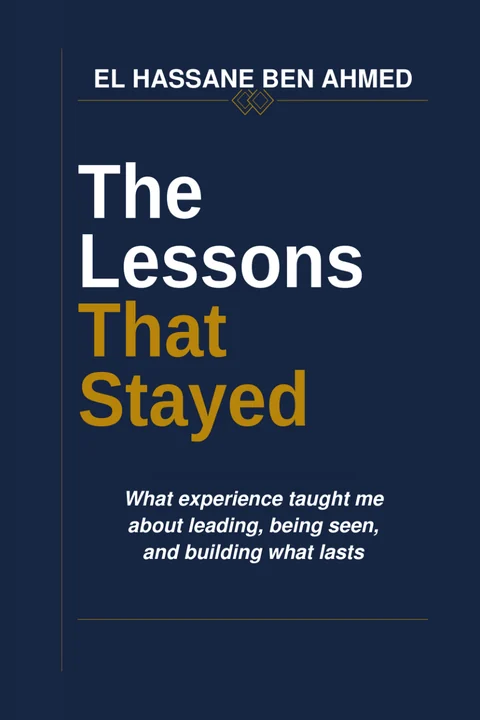
The Lessons That Stayed: Book Summary, Themes and Key Lessons
A complete overview of The Lessons That Stayed by El Hassane Ben Ahmed: its argument, its four parts and twenty chapters, the lessons it draws, and who it is written for.
Key takeaways
- The Lessons That Stayed is a leadership book by El Hassane Ben Ahmed, published in 2026 in English, available on Kindle, in paperback and in hardcover.
- Its central question: why does excellent work sometimes fail to bring recognition?
- Its answer: organisations are social systems that reward what is visible, structurally supported and sustained by culture, not automatically what is excellent.
- It has twenty chapters in four parts: Recognition, Culture, Structure and Performance. Each chapter opens with a story from history.
- It draws on more than thirty years of leadership in ten countries and on more than 250 research references.
On this page
The Lessons That Stayed: What experience taught me about leading, being seen, and building what lasts is a leadership book by El Hassane Ben Ahmed. It asks a question most professionals meet sooner or later: why does excellent work sometimes fail to bring recognition?
The book’s answer is that results matter, but so do the relationships, cultures and structures around them. Organisations are social systems, and social systems do not automatically reward what they should.
“Excellent work is not enough. The organisations within which careers are built are social systems, and social systems do not automatically reward what they should.”
About the book
- Author: El Hassane Ben Ahmed
- Published: 2026
- Language: English
- Formats: Kindle, paperback and hardcover, on Amazon in the United States, Canada and France
- Structure: 20 chapters in 4 parts, with a foreword, an introduction, a general conclusion, an afterword and a full bibliography
- Research base: more than 250 references
The chapters began as reflections the author shared on LinkedIn. He wrote them over time, in no particular order and with no plan for a book. He recognised the structure afterwards, when he placed all twenty side by side and saw that they formed a single argument.
What the book is not
The foreword, titled What This Book Is Not, sets three limits. The book does not claim to resolve the problems it describes, because they are structural features of complex organisations. It does not offer universal prescriptions: Lincoln’s approach worked in Lincoln’s cabinet, Mandela’s in South Africa, and the lesson is to understand why something worked, not to copy it. And it does not pretend the lessons were easy to learn. The title comes from that idea: not all lessons stay, only the ones that arrived with enough friction to change how you see.
“Not to tell you what to do. To help you understand what you are looking at.”
How each chapter works
Every chapter opens with a short personal note in which the author describes a situation he lived through. It then turns to a figure from history, such as Nikola Tesla, Rosalind Franklin, Abraham Lincoln, Nelson Mandela or Ernest Shackleton, whose story illuminates the same pattern. The chapter then connects that story to management research and original argument, and closes with what the author took from the experience.
The four parts
Part I: Recognition
On being seen for what you actually contributed. Why contribution becomes invisible, how credit is taken rather than earned, how a manager’s first impression can harden into a fixed judgement, when leaving without another job is the right decision, and what to do when you have done everything right and it still does not work.
- I.1 The Lesson I Learned About Visibility
- I.2 When Recognition Is Taken, Not Earned
- I.3 When Your Manager Has Already Decided About You
- I.4 When to Leave Without Another Job in Hand
- I.5 When You Have Done Everything Right and It Still Does Not Work
Part II: Culture
On the environments we build and the ones we endure. How fear-based leadership produces compliance instead of commitment, why leadership styles do not travel across cultures, how proximity replaces merit, why inconsistency is the most dangerous leadership trait, and what double standards do to a team.
- II.1 Intensity vs Impact: The Leadership Paradox
- II.2 Your Leadership Style Requires an Upgrade
- II.3 When Merit Became Optional
- II.4 The Most Dangerous Leadership Trait No One Talks About
- II.5 When Leaders Break the Rules They Enforce
Part III: Structure
On the architecture of authority and the cost of leaving it unnamed. How co-management works and fails, what happens when senior leaders bypass their managers, the leader who cannot read uncertainty in a project, how to keep strong employees when personalities differ, and the manager who deflects accountability.
- III.1 When Co-Management Becomes Complicated
- III.2 Presence Without Disruption
- III.3 The Most Dangerous Leader in a Project
- III.4 How Strong Leaders Keep Their Best Employees When Personalities Differ
- III.5 The Manager Who Deflects and Disconnects
Part IV: Performance
On what genuine excellence requires, and what it cannot afford to ignore. How empathy, strategy and authenticity combine, what sustained performance under pressure demands of individuals and organisations, how to lead in difficult times, the real cost of cheap consulting, and what enduring organisations do differently.
- IV.1 The Complete Leader: Fusing Empathy, Strategy, and Authenticity
- IV.2 Excellence Under Pressure
- IV.3 Leading in Difficult Times
- IV.4 The Harsh Truth
- IV.5 What Enduring Organisations Do Differently
The four lessons
In the afterword, the author names what each part taught him.
- Recognition: results do not speak for themselves. Value is created by individuals and attributed by systems, and those systems favour whoever controls the narrative.
- Culture: fear produces movement but not performance. Compliance and commitment can only be told apart over time.
- Structure: the hardest conversations should happen early. Structural problems are correctable, and the cost of not correcting them is paid later, at a higher price.
- Performance: excellence is a joint product of individual discipline and the right organisational conditions. Neither substitutes for the other.
The general conclusion argues that these are the same argument seen from four positions: the individual professional, the team member, the person who designs authority, and the person responsible for outcomes.
The lesson underneath
The book’s deepest lesson is a way of reading situations. When something goes wrong in an organisation, the author suggests asking not what is wrong with the person, but what conditions are producing the behaviour; not who is at fault, but what structure is generating the fault. Understanding problems structurally rather than personally, he argues, is both more accurate and more useful, because it points to changes that actually alter outcomes.
The afterword ends with a sentence that gives the book its tone:
“That is the lesson I still carry. I hope some of it stays with you too.”
Who should read it
- Individual contributors and early-career professionals whose good work is not being seen, and who want to understand why.
- Managers and team leaders who want teams where effort is recognised, people speak up and standards hold under pressure.
- Senior leaders and executives responsible for the structures, decision rights and cultures their organisations depend on.
The book’s own description of its reader is short: it is written for professionals who do excellent work in places that have not yet learned to see it.
About the author
El Hassane Ben Ahmed has spent more than thirty years leading water utilities and teams in ten countries across Africa, the Middle East and South Asia. His work has taken him into organisations under pressure, where services needed to improve, budgets were tight and people faced difficult change. That experience taught him the lesson that runs through his writing: delivering results and earning recognition do not always go together.
Frequently asked questions
What is The Lessons That Stayed about?
It is about the gap between doing excellent work and having that work recognised, and about the cultures, structures and leadership behaviours that widen or close that gap. It combines the author’s own experience, historical case studies and management research.
Who wrote The Lessons That Stayed?
El Hassane Ben Ahmed, a leader with more than thirty years of experience running water utilities and teams in ten countries across Africa, the Middle East and South Asia.
Who is the book for?
Professionals who do excellent work in environments that have not yet learned to see it, managers who want to build teams where good work is recognised, and senior leaders responsible for the structures and cultures their organisations run on.
Is it a leadership framework?
No. The author is explicit that it is not a system or a set of universal prescriptions. It is a record of situations he encountered, understood as clearly and honestly as possible, connected by one argument.
Where can I buy The Lessons That Stayed?
On Amazon in the United States, Canada and France, as a Kindle e-book, a paperback and a hardcover. The book is written in English.
Sources
This guide is based on The Lessons That Stayed by El Hassane Ben Ahmed (2026). Quotations are from the book.
- Ben Ahmed, E.H. (2026) The Lessons That Stayed: What experience taught me about leading, being seen, and building what lasts